If your page isn't indexed by Google, it doesn't exist. No rankings, no traffic, no results — no matter how good your content is. In this guide, we break down exactly how Google indexing works, what to expect at every stage, and how QuickIndexing.com helps thousands of SEO professionals skip the waiting game entirely.
What Is Link Indexing?
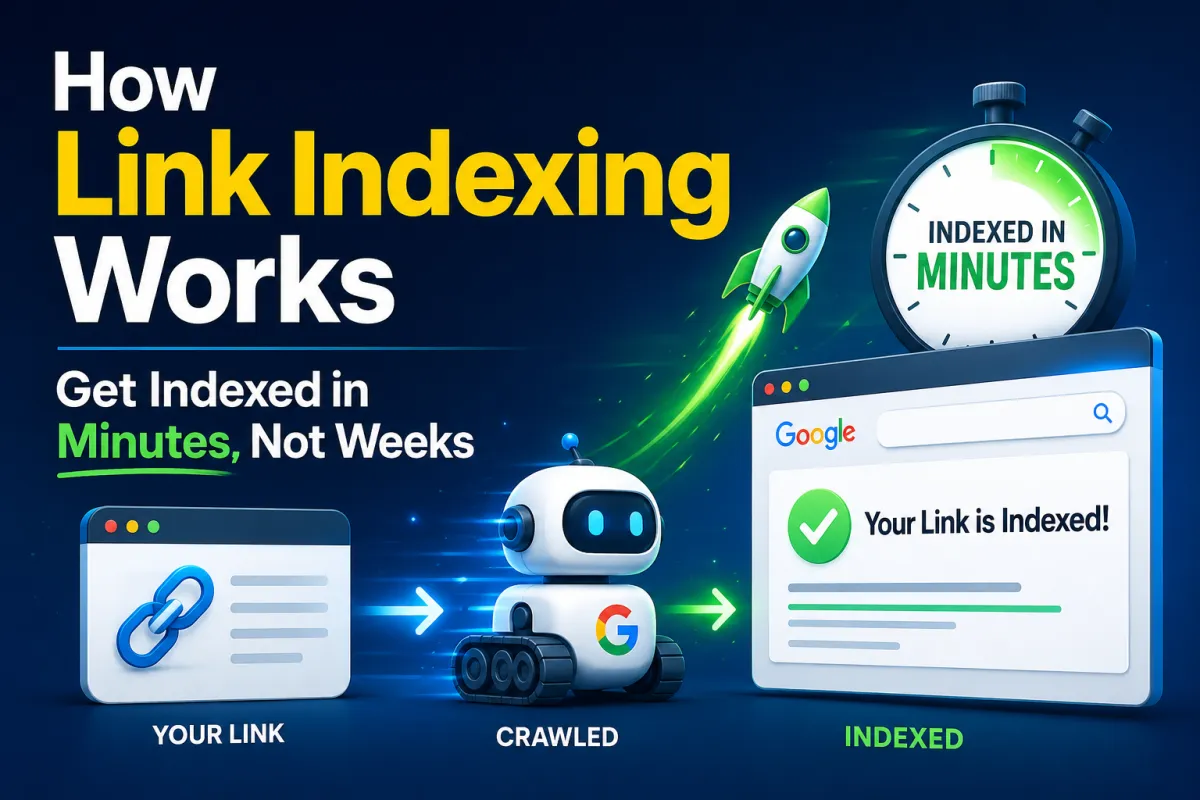
Link indexing is the process by which Google discovers, crawls, and stores your web pages in its database. Think of Google's index as a giant library — your webpage is a book. Until that book is added to the catalog, no one can find it.
Not indexed = Does not rank = Zero organic traffic.
How Does Google's Indexing Process Actually Work?
Google uses automated bots called Googlebot to discover new content. Here is the complete step-by-step process:
Step 1 — Discovery Google finds your URL through backlinks, sitemaps, or direct submissions via Google Search Console.
Step 2 — Crawling Googlebot visits your page and reads its content, structure, and internal links.
Step 3 — Processing Google analyzes the page — checking content quality, spam signals, keyword usage, and domain history.
Step 4 — Indexing If your page passes Google's quality check, it gets stored in the index and becomes eligible to rank.
Step 5 — Ranking Once indexed, your page competes in search results based on relevance, authority, and user signals.
How Long Does Indexing Normally Take?
This is where most website owners lose valuable time and traffic.
| Situation | Expected Indexing Time |
|---|---|
| New website, no authority | 2 – 8 weeks |
| Established domain, good authority | 3 – 7 days |
| High authority domain | A few hours |
| Manually submitted via Search Console | 1 – 14 days (no guarantee) |
| Submitted via QuickIndexing.com | Minutes to a few hours |
The painful truth? You can publish great content today and wait weeks before Google even notices it — unless you take control of the process.
What to Expect During the Indexing Process
✅ Best Case — Fast Indexing
Your domain has strong authority, clean backlinks, and original content. Google indexes your page within hours.
⚠️ Average Case — Delayed Indexing
Your domain is new or has average authority. Indexing takes days to weeks. Your content starts ranking late and misses early traffic windows.
❌ Worst Case — Never Indexed
Your page never gets indexed due to domain penalties, spam signals, thin content, or crawl budget issues.
Can You Speed Up or Bypass the Waiting Period?
Yes — and this is exactly what QuickIndexing.com was built for.
While Google's organic crawling is unpredictable and slow, QuickIndexing.com connects directly to Google's Indexing API and pushes your URLs for immediate processing — completely bypassing the organic crawl queue.
The Manual Way (Slow & Uncertain)
- Submit URLs one by one via Google Search Console
- Update your XML sitemap and hope Googlebot visits
- Build backlinks and wait for natural discovery
These methods work eventually — but offer zero control over timing.
The Smart Way — QuickIndexing.com
QuickIndexing.com sends your URLs directly to Google the moment you click submit. No waiting. No guessing. No crawl queue.
What you get:
- ⚡ Pages start competing in search results right away
- 🔗 Backlinks get discovered and credited by Google sooner
- 🕐 Time-sensitive content — offers, news, promotions — indexed before they go irrelevant
- 🏆 You stay ahead of competitors still waiting on organic crawling
Think of it like the difference between mailing a letter and sending a direct message. Same destination — completely different speed. That is what QuickIndexing.com does for your SEO.
How QuickIndexing.com Works Behind the Scenes
No black hat tricks. No risky workarounds. Here is exactly what happens:
- You submit your URLs on QuickIndexing.com
- QuickIndexing instantly pings Google's official Indexing API
- Google receives your URL and queues it for immediate processing
- Google's quality algorithm evaluates your page
- Page passes quality check → Indexed and ready to rank
QuickIndexing.com guarantees steps 1–3 with a 100% submission success rate. Steps 4–5 depend on your content and domain quality — as they should. No legitimate tool overrides Google's algorithm.
Why Is My Page Still Not Indexed After Submission?
Even after submitting through QuickIndexing.com, some pages may not get indexed. Here is why — and it has nothing to do with the submission:
Penalized Domain
Manual or algorithmic Google penalties block indexing at the domain level before quality is even assessed.
High Spam Signals
Keyword stuffing, bad backlink patterns, or auto-generated content gets automatically filtered by Google — regardless of submission method.
Low-Quality Content
Google asks: "Is this page genuinely useful to a real user?" If the answer is no, the page gets skipped.
Active Core Update
During Google Core Updates, quality filtering runs at peak sensitivity. Borderline pages often fail to get indexed during these periods.
How to Test Your Domain Before Bulk Indexing
This is the smart workflow that experienced SEO professionals follow before bulk uploading on QuickIndexing.com:
Step 1 — Select 2–3 URLs from your domain
Step 2 — Submit them via QuickIndexing.com
Step 3 — Wait 1–5 minutes, then check: site:yourdomain.com/your-page in Google Search
What the result tells you:
- ✅ Indexed instantly → Domain is healthy. Scale up with confidence.
- ❌ Not indexed → Fix domain quality issues first. Bulk submission won't help a penalized or spammy domain.
This simple test saves your credits, your time, and gives you precise domain intelligence before committing to a full project.
Factors That Directly Affect Your Indexing Success
| Factor | Effect | Best Practice |
|---|---|---|
| Domain Authority | High authority = faster indexing | Build quality backlinks consistently |
| Content Originality | Original content = priority indexing | Always publish unique, valuable content |
| Keyword Spam Density | High spam = automatic filtering | Keep keyword usage natural |
| Domain Penalty Status | Penalized domains rarely get indexed | Test on QuickIndexing.com before bulk upload |
| Page Freshness | Fresh pages index faster | Update your content regularly |
| Google Core Updates | Stricter filtering during updates | Reduce bulk submissions during update periods |
Pro Tips for Maximum Indexing Success with QuickIndexing.com
Test before scaling — Always submit 5 URLs first on QuickIndexing.com. Confirm indexing. Then go bulk.
Domain quality is everything — QuickIndexing.com performs best with clean, authoritative domains. A good domain + fast submission = unbeatable results.
Avoid keyword-stuffed pages — Google filters these before they are ever indexed. No submission tool can save a low-quality page — fix the page first.
Submit fresh content first — Newly published pages respond best to instant indexing submissions.
Watch Core Update periods — Scale back bulk uploads when a Google Core Update is active.
Every page must earn its place — Ask: "Does this page genuinely help someone?" If yes, submit it. If not, improve it first.
Summary
Google's indexing process is powerful — but painfully slow for anyone serious about SEO. Waiting days or weeks for organic crawling means lost rankings, lost traffic, and lost revenue.
QuickIndexing.com changes that. By connecting directly to Google's official API, it gives your pages the fastest possible entry into Google's index — turning a weeks-long wait into a matter of minutes.
Clean domain. Quality content. Smart submission strategy. That combination — powered by QuickIndexing.com — is how top SEO professionals stay consistently ahead of the competition.
The crawl queue is optional. Stop waiting. Start ranking.